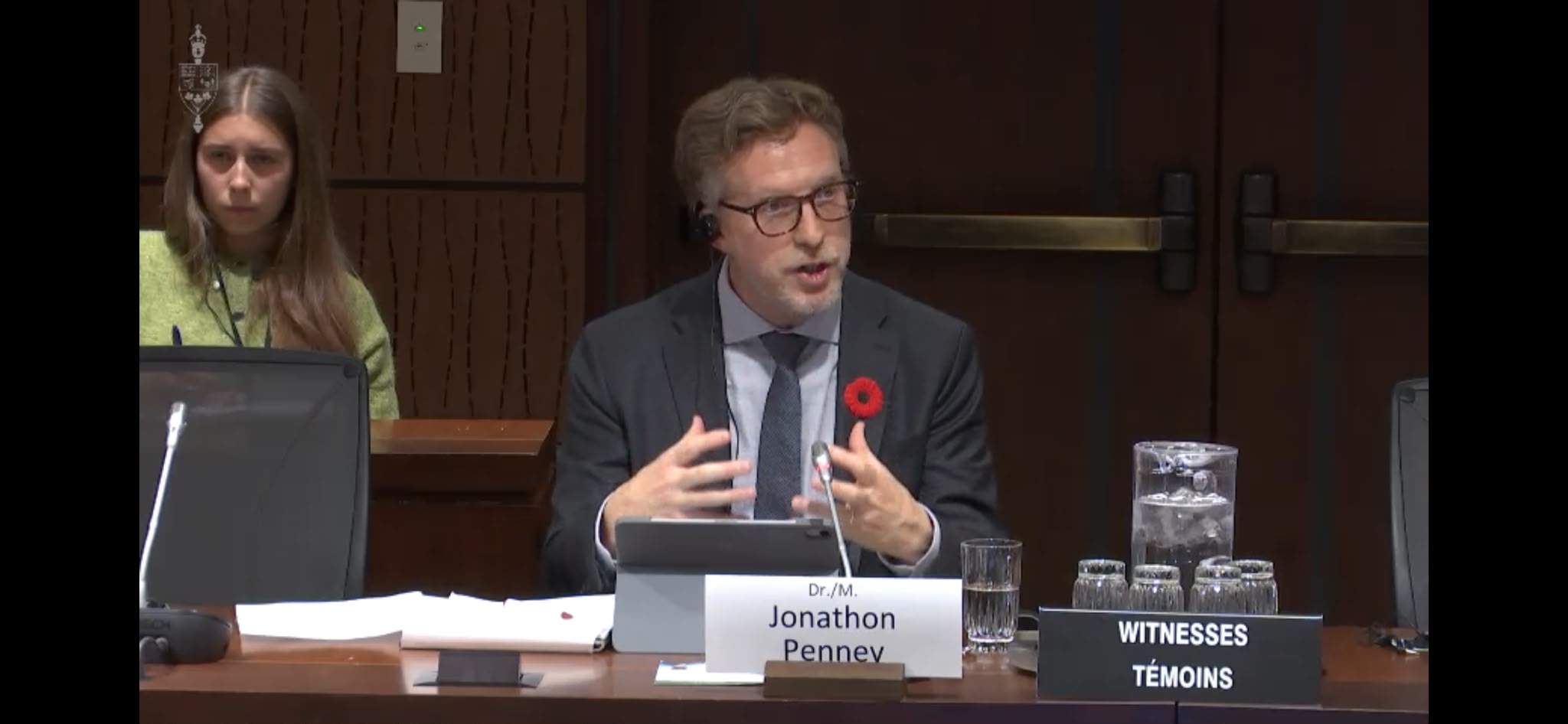
Statement of Jonathon W. Penney to the House of Commons of Canada’s Sub-Committee on International Human Rights Regarding its Study of the Global Impact of Artificial Intelligence on Human Rights Movements
Thank you, Mr. Chairman.
In an op-ed published in The Guardian this past July, myself and renowned security technologist Bruce Schneier argued that very soon, AI-enhanced surveillance will be able to track everything we do in public, much of what we do in private, and in real time, it track us, log our activities, and report legal violations. Think of these systems as automated speed cameras, but on steroids. We argued that such systems would have far reaching chilling effects within and across societies wherein such systems are deployed – including a deep chill on social progress, like human rights activism.
But AI is not only supercharging mass surveillance, but many other tools in the repressors toolkit. Last month, AI company Anthropic described how a China-connected operator used a commercial AI platform (Claude) to track Uyghurs in Syria. The AI located them, identified ways to threaten and blackmail—flagging those, for instance, suffering financial hardships or with family back in Xinjiang. The same report described a China-linked operator likewise researching a protest route right here in Canada—in Vancouver.
In March, an investigation led by Forbidden Stories, with Le Monde and Der Spiegel, revealed that Iran had secretly bought FindFace, an AI facial recognition system made by the Russian company NtechLab. FindFace can ID people in a crowd in seconds and map the person’s entire social network—family, friends, work colleagues, any relationships. The New York Times reported that detained Iranian protestors were interrogated using facial recognition matches.
And it’s not just authoritarian states. For instance, in 2025, the US State Department launched an AI powered effort called “Catch and Revoke” to monitor student visa holders social media activities; about 300 visas were revoked within weeks. ICE, too, is deploying AI to track immigrations and protesters.
In this new world, the global impact of AI on human rights movements and activism will be profound.
First, AI is making surveillance and human rights abuses easier, cheaper and more effective.
Xinjiang remains a clear example. Facial recognition checkpoints and predictive policing have flagged Uyghurs for detention for praying, for their phone contacts, for travelling abroad. Iran uses drones, facial recognition at university gates, and a state app for reporting female students not conforming to dress codes. In Mali, one contractor reportedly used an AI platform to help write code to build a system monitoring about 25 million SIM cards.
AI is automating everything, to make the human rights abuser’s work quick, efficient, and seamless. It’s easy to abuse human rights in a world of AI.
Second, AI makes human rights activism harder
AI enhances targeted surveillance of journalists and dissidents. My colleagues at the Citizen Lab have done extensive work on the – NSO Group, the Israeli security firm, developed spyware used and abused against activists and dissidents the world over. Spyware made by another firm, Paragon, targeted Italian journalists. A reporter that cannot promise confidentiality loses their sources.
AI enables threats and harassment at scale. Language models let operators produce personalised intimidation in any language, at volume. We have seen sexualized deepfakes used to victimize female critics of governments abroad, including here in Canada.
It helps spread confusion. During Iran’s protests and internet blackout in January, AI-generated protest videos drew millions of views. When people cannot tell what is real, they hesitate to act together.
And it concentrates power in platforms. In Brazil’s election, President Lula’s campaign alleged that Meta’s algorithms throttled the reach of his posts. Meta denies it, but Brazil’s electoral court did act and ordered the company to treat both candidates equally.
Why this works
In Orwell’s 1984, even Big Brother, with a telescreen in every room, depended on the citizens of Oceania to censor themselves. Repression works best when people silence themselves and disengage from activism.
In my new book Chilling Effects: Repression, Conformity, and Power in the Digital Age (Cambridge University Press, 2026), I explore how surveillance, censorship, and technologies—especially AI—are being increasingly weaponized by governments, companies, and extremist actors to chill, repress, and shape behavior at scale, with grave implications for human rights and democracy.
In the book, I identify four factors that drive these impacts: observation, uncertainty, personalization, and power/authority. AI amplifies every one. It makes observation pervasive. Its opacity breeds uncertainty about who and what is watched and what will happen. Its profiling makes threats personal. And it concentrates power in states and companies that answer to almost no one.
What we should do about it
We know how these systems operate, how they impact, address each factor:
One, observation: restrict surveillance. Canada should set clear legal limits on government use of AI facial recognition and social media monitoring, with a moratorium at peaceful protests. And it should work with allies to shut down the mercenary spyware market.=
Two, uncertainty: require transparency. AI companies should publicly report when their tools are used for transnational repression, notify the communities targeted, and preserve evidence for accountability, as Citizen Lab researchers have urged.
Three, personalization: put controls and pricing on profiling. Limit profiling and advocate for strict data minimization laws and regulations at home and abroad, and make excessive data collection costly. Place new duties and responsibilities on these powerful tech companies to reduce monetary incentives for profiling and make abusive tech more costly.
Four, power: make enablers accountable. AI regulation that is made-in-Canada but a model for the world. New reasonable care and data loyalty duties for platforms and their algorithms. Companies that build or sell tools of repression should face mandatory human rights due diligence, export controls, and legal liability. Canada should likewise lead and reverse course on the very recently scrapped Canadian Ombudsperson for Responsible Enterprise (CORE); our only watchdog for abuses by Canadian companies abroad. CORE should be revived, empowered with real investigative powers, and its mandate extended to Canadian tech firms whose products enable harms.
This is a real moment for Canadian leadership on the impacts of AI on human rights around the globe. I thank the committee for the invitation to speak.

